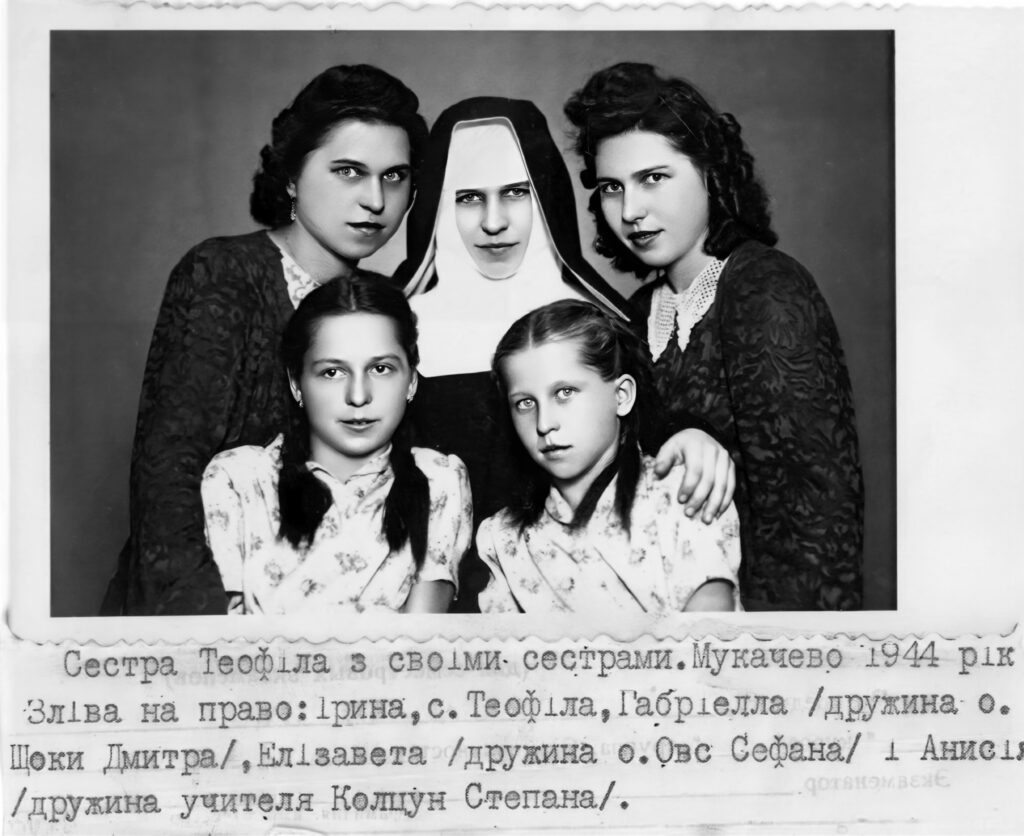
The name of Sister Mária Teofila Manajló, a Basilian nun, is linked by many to that of Blessed Teodor Romzsa (Theodore Romzha), as the nun cared for the bishop, who was the victim of an assassination attempt, during his final days in October 1947.
Sister Teofila, who herself endured a labor camp, only dared to speak decades later about what happened in the Mukachevo hospital and how the Soviet regime executed the confessor bishop.
Sister Teofila was born Mária Manajló on March 28, 1920, in Ungvár (Uzhhorod). She grew up in a Greek Catholic priestly family; her father was Father Pál Manajló and her mother was Irén Kopcsay. Of her six siblings, three became Basilian nuns.
After finishing elementary and secondary school in Ungvár, and then the teacher training college, she herself entered the Basilian Order in 1936. She took her perpetual vows in 1945.
She served as the nurse for Bishop Teodor Romzsa—who had been attacked and severely wounded by Soviet agents—at the Mukachevo hospital between October 27 and 31, 1947.
She spent days vigilantly watching over the bishop, who was already recovering. However, she was lured out of the ward for a few minutes, and while she was away, a KGB agent disguised as a cleaning woman administered a fatal injection to Bishop Romzsa, who died instantly. Sister Teofila, upon returning to the ward, could do nothing for him.
Her trials, however, were just beginning. She was arrested on January 26, 1948. They tried to prove that she had been complicit in the murder of Teodor Romzsa. She was interrogated in Kyiv for six months, and since they failed to convict her of the murder, she was sentenced on August 21, 1948, on other charges, to ten years of forced labor, five years of deprivation of civil rights, and confiscation of property. She was imprisoned in the territory of the Mordovian ASSR, working as a nurse in the camp hospital.
She was released home in 1955. She moved to Ungvár to live with her sister and worked as a nurse at the city hospital until her retirement in 1990. Alongside her secular work, she remained faithful to her monastic vows: she cared for patients outside the hospital, visited the elderly, and prayed.
In 1989, she was acquitted of the 1948 charges and rehabilitated. She lived to see the legalization of the Greek Catholic Church.
In 1990, she documented the circumstances of Bishop Romzsa’s murder. She participated in the identification of Bishop Romzsa’s relics.
Sister Teofila passed away in Ungvár on January 5, 2007, at the age of 87, in the 61st year of her religious life.