



Ilona Turzay
Limitless Faith
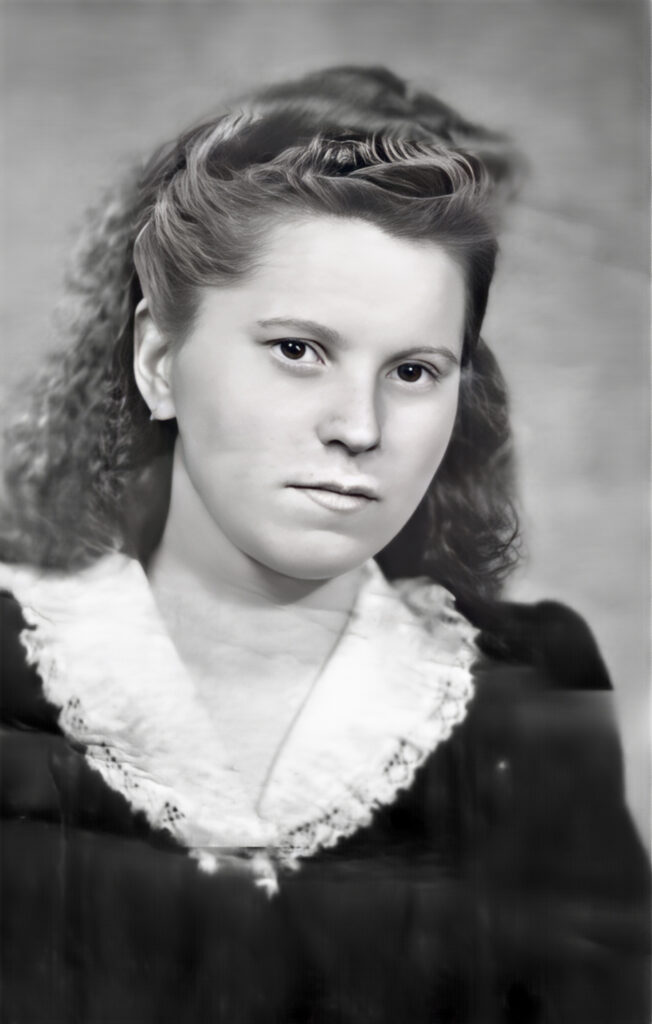
In the Greek Catholic church of Beregszász (Berehove), the 91-year-old Auntie Ilonka Turzay is well known. While it’s true that she hasn’t been able to attend the Holy Liturgies for a few months due to her health, she prays at home for her four-generation family.
Auntie Ilonka is a living example of 20th-century Subcarpathian history: she was born during the Czechoslovak period, seeing the light of day in Mátyfalva (Matiyevo) in 1934. She began elementary school “under the Hungarians,” but by the time she reached the upper grades, it was already the Soviet era. She also spent her adulthood under the communist regime: she completed university, got married, gave birth to children, and taught. She reached her retirement years as a citizen of independent Ukraine in Beregszász—as a Hungarian. She taught for over 50 years. She and her husband lived in a happy marriage for 54 years, having two children, three grandchildren, and six great-grandchildren.
Auntie Ilonka experienced World War II as a teenager. She remembers the events well. There was great poverty at the time. They heard the Soviet front was approaching, so she and her neighbors dug a bunker at the end of the garden and filled it with food to have something left when the Russians arrived. When the war was lost and the bells of the Reformed and Greek Catholic churches rang, she cried bitterly because she was afraid of what would happen to them. Her father was on the front, and they didn’t know if he would ever return home. He was eventually freed from captivity and came home.
Their lives were spent in poverty. The Soviets took their land, their livestock, and their thresher. Her father long refused to join the kolkhoz (collective farm). Because of this, he was locked up in the council house for two days. He eventually gave in; he had no other choice.
Auntie Ilonka was in the fourth grade when the Soviets marched in. They had never heard a Ukrainian or Russian word in the village before. Ukrainian-language education was introduced in the school. They didn’t understand anything they were taught, nor did they want to speak Ukrainian or recite poetry. Only four grades operated in Mátyfalva. They began their upper-grade studies in Tiszaújlak (Vylok), seven kilometers away. Teaching was also in Ukrainian there. They walked to school, or stayed in the village during the winter. It was there that they experienced the Tisza flood of 1947. They waded home in knee-deep water. The school was also damaged in the flood, so from then on, they studied in the neighboring village, Tiszaújhely (Tysa), where a Ukrainian school had opened in the meantime.
She completed secondary school in Beregszász, at the high school on the bank of the Vérke river. She wanted to become a teacher. At the time, one year of practical school experience was required before university admission. She was assigned to the Hungarian school in Verbőc (Verbiazh). She became the first-grade teacher. The village was three kilometers from Mátyfalva, and she walked to school. In winter, she rented a room in Verbőc. The deputy principal encouraged her to apply to Kyiv to study biology. She successfully entered the university, where she studied for five years by correspondence. Meanwhile, she got a job as a biology teacher at the local secondary school in Tiszapéterfalva (Pyterfolvo). She was there for seven years, teaching the students in Hungarian.
In the meantime, she started a family… Her husband, Sándor, was also from Mátyfalva, working as a mathematics-physics teacher. They married in 1955. A year and a half later, their son, István, was born. She was only allowed to stay home with him for 52 days before she had to return to work. Auntie Ilonka was teaching in Tiszapéterfalva, and her husband was relocated to Nagybégány (Velyka Beihan). Eventually, the education inspector took pity on them, and her husband got a job in Fancsika (Fanchykovo), next to Mátyfalva. A year later, Auntie Ilonka was transferred to Tiszaújhely as a German teacher. From there, she later moved to Mátyfalva, where she taught German for 27 years. During this time, she completed a German major at the university in Kyiv. She and her family lived first in Mátyfalva, then built a house in Ruszka Dolina (Rús’ka Dolina), next to the village. After their son, their daughter, Éva, was born.
Auntie Ilonka came from a religious family. At the age of eight, she walked all the way to Máriapócs (a major pilgrimage site). She knew all the Marian hymns. Her husband also received a religious upbringing. However, as teachers, they could not publicly practice their faith. In fact, at Christmas, they were sent out onto the street to spy on the children singing carols. But she never hurt the children because of their religion; on the contrary, she encouraged them to pray. In secret, she herself tried to preserve her religious faith. Once a month, she traveled to Ungvár, where no one knew her, and there she confessed and took communion. Her daughter’s church wedding and her grandchildren’s baptisms also took place in secret.
In the meantime, significant changes occurred in the family’s life: after their children settled in Beregszász, Auntie Ilonka and her husband also moved to the town on the Vérke river in 1987. They lived in a shared house with their daughter’s family.
Auntie Ilonka continued teaching. She first became a German teacher in Beregszász, and then in Beregsurány (in Hungary).
Then, after 54 years of marriage, Auntie Ilonka became a widow in 2002. She remained with her children and grandchildren. The family has grown in the meantime: her three grandchildren have had six great-grandchildren. The years have flown by; Auntie Ilonka turned 91 last year. She has overcome numerous illnesses, and although she is physically weak, she is mentally very fresh, and spiritually, she remains the unifying force of the family to this day.