



Karolina Temető, Józsefné Petrás
- Transcarpathian Day in Brussels 2025
- Faces from the Past – A Nostalgic Photo Collection from Transcarpathia
- Karolina Temető, Józsefné Petrás
Karolina Temető, Józsefné Petrás
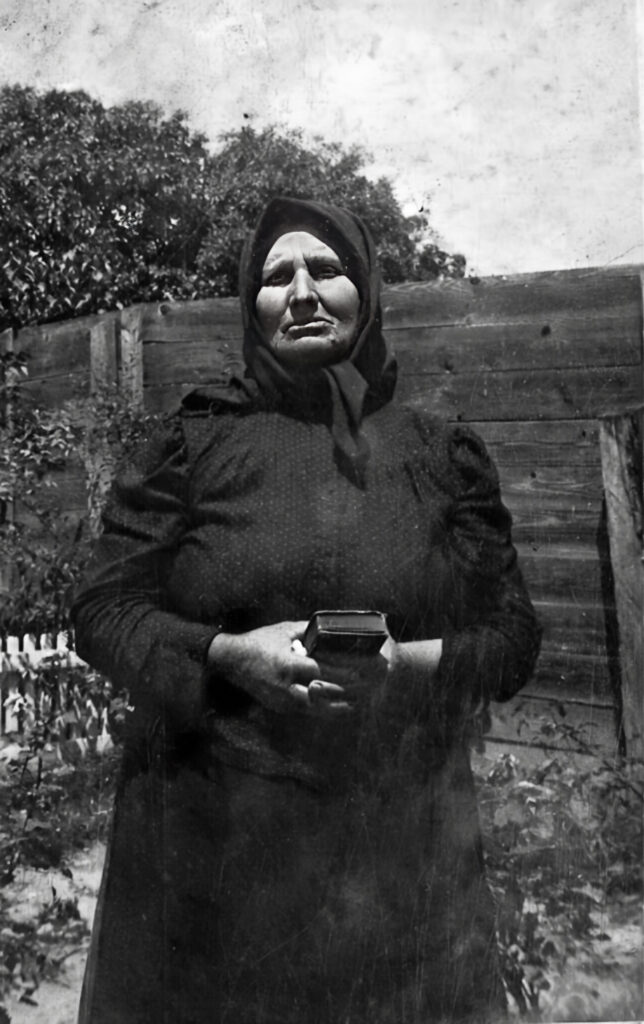
Grandma Karolina
My great-grandmother, Karolina Temető, née Petrás Józsefné, was born in Nagybégány (Velyka Beihan) on June 12, 1881. Even as a child, she was a hard-working, industrious soul. She worked in the kitchen as an assistant, and later became the family cook, at the manor of the Nemes family, who lived in our village.
The Nemes family grew very fond of her, and when she got married, they gave her the plot of land where we still live today as a gift. In 1905, they built a neat little house on it, the blueprints of which we still keep.
Later, my great-grandparents decided that the head of the family would go to California to work, to secure a livelihood for the family. He succeeded in this, but the heavy burden of raising four children and managing the farm fell upon Grandma Linka.
Then came World War I, the years of which she lived through alone with her children. Following that was the Treaty of Trianon. I remember her speaking tearfully about the day the villagers prayed together that they wouldn’t be separated from their homeland, but sadly, not even prayer saved Subcarpathia (Kárpátalja). The evil force unleashed in the 20th century was stronger than anything.
Then came the family tragedies. Of their four children, they tragically and suddenly lost one of their sons in an accident.
Not long after, World War II broke out, and then in 1944, the village’s more prosperous families were declared kulaks. Our family was betrayed by their own farmhands. Even though my great-grandmother provided them with generous wages and dinner for their families at home, the next morning the farmhands arrived with Soviet soldiers, red armbands on their arms, and dragged away my great-grandparents’ son, Pál, for “three days of work”—malenkij robot (forced labor). They took everything: machinery, tools, livestock, and even swept the attic clean. They left behind an empty yard and the empty bed of my great-grandparents’ son. But of all this, my great-grandmother only mourned her child. She later received him back alive but disabled; my Uncle Pali was bedridden and immobile for 22 years.
A short time later, her grandson, my father, was also taken from her to the Donbas. He was sentenced to 25 years in prison. He was released five years later, having lost the sight in one eye. Meanwhile, a Soviet military officer was billeted in our home. His wife plowed up the yard to plant potatoes there. Grandma Linka—setting aside her pride—knelt before her and begged them to leave the flowers, as she needed them for her son’s grave. The officer pointed a pistol at her and shouted: “Get out or I’ll shoot you!”
This was too much hardship for her. From so much crying—evidently on a nervous basis—she lost her sight, and lived the rest of her life this way.
The many difficulties, sorrows, and grief did not shake her faith in God. She prayed a lot; every Sunday, she had to be led to church.
I learned everything from her: to pray, to believe, and to trust in the Lord—this is the most important thing! “Do not forget, my daughter, whatever sorrow befalls you, God loves best the one whose shoulders he places the heaviest burden on”—she always comforted me with this whenever something troubled me.
I did not have an average childhood, filled with carefree playing, like most children. But for this, I am grateful to the good Lord and to fate. I was born into living history; as a child, I felt and experienced the all-destroying power of communism. I helped in any way a child could. While my parents worked three shifts, and my grandmother tended the garden, the elderly were entrusted to me. I looked after my helpless Uncle Pali and my blind Grandma Linka. This is how I grew up amidst the sad tales written by life, between Prince Árgyélus and Ilona the Fairy. And with beautiful church hymns and Hungarian folk songs that Grandma Linka sang and taught me in her clear, ringing voice.
Now, decades later, at the end of Mass, the congregation in the church sings the Queen of the Rosary, and I am a child again; my voice falters, and I hear the old mother, feeling her trembling hand as she squeezes mine while we lead her.
Jolika Petrás, Nagybégány