


Dorina Bacskai
Dorina Bacskai
One Heart, Two Hands
There are moments in a woman’s life when she doesn’t just step onto a new path, but when an entirely new world opens up before her. It’s when the dreams of girlhood become reality, when the carefully braided pigtails are replaced by a headscarf, and the light steps of dancing give way to the rhythm of the family home. A wedding isn’t merely a day in the flow of life; it’s a gate. Stepping through it, a woman no longer lives only for herself, but breathes in sync with the beat of another heart, becoming part of a shared destiny—one who will now create a home, tend the fire, and give love.
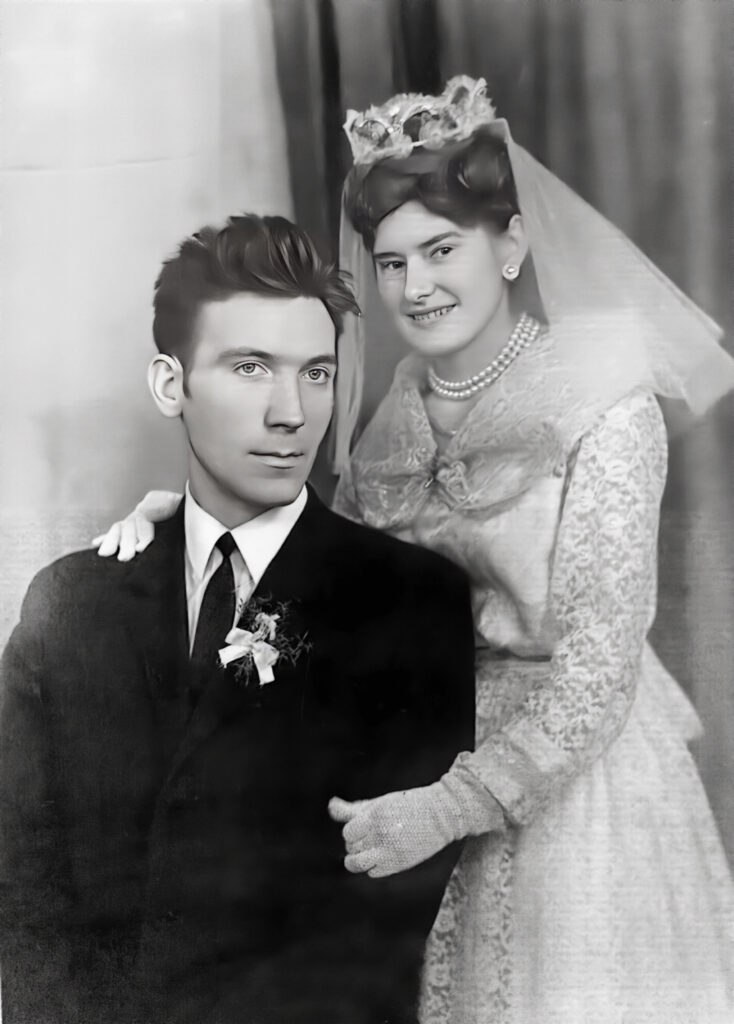
My grandmother, whose maiden name was Erzsébet Bellák, married László Ladányi on November 19, 1967—exactly on her name day, Elizabeth Day. They grew up in the same village, went to the same school, and their lives became intertwined almost without them noticing. Their path wasn’t always easy. When my grandfather enlisted in the army, they were separated for long months, even years. Distance didn’t weaken their bond—quite the opposite. Letters preserve their faithfulness, holding confessions of waiting, hope, and never-ending love concealed within their lines.
In those times, when a girl began to grow up, her mother would start embroidering the best man’s sashes (vőfélykendő), which were gifted to all the male participants of the wedding feast on the big day. Later, when the girl was old enough, they would sew these together. Naturally, the duvet and pillows must be mentioned; the new wife was obliged to bring them as a dowry, and her mother was responsible for arranging their creation. Some ordered them ready-made, while others gathered the village women for feather-plucking parties and prepared them themselves.
Leading up to the big day, the relatives were already busy cooking up the most delicious dishes. Due to the unpredictable weather of November, the feast took place inside the house, but the area reserved for dancing was protected by a tent, where the whole village community, young and old, celebrated while a large string orchestra played dance music all night long. Besides the cooking and baking, clearing out three large rooms and setting up the tent also required many industrious hands from the extended family.
I think my grandmother’s wedding dress was a dream—she rented the beautiful gown in Munkács (Mukachevo), while the crown was brought from Szalóka (Solovka) by Márta Nagy. At midnight, the wedding dress was replaced by the young wife’s dress (menyecskeruha), and, of course, a headscarf was placed on the girl’s head (usually tied on by her mother). The community of Eszeny (Esen’) has always been deeply religious, and the church wedding held outstanding significance in their lives. No matter what difficulties or obstacles they faced, they did everything to uphold the church part of the wedding in a worthy manner. My grandparents’ wedding was no exception, and a memorable story is attached to their big day. As my grandparents were about to leave for the church, an unusual event intervened. The Reformed pastor at the time, János Orémusz, sent a message that another bride was arriving from Oncsa (Onokivtsi), and the two brides must not meet on their way. According to the belief in Eszeny, if two brides see each other on their wedding day, their marriage will be unlucky. In the end, my grandparents did not leave the house; instead, the pastor himself came to them to marry them there. The pastor was, of course, hosted and fed after the ceremony.
The waiter was the bride’s oldest brother, János Bellák, who lovingly served the relatives. The music was also unforgettable, as my great-grandfather, a great violinist, couldn’t resist joining the orchestra himself during the evening to play some dance tunes. The wedding thus became not just an event, but a communal creation where every family member contributed their love and effort to make the day unforgettable. And indeed, the goal was fulfilled, as 58 years have passed since then, and my grandparents still tell me, their granddaughter, the story of one of the most beautiful days of their lives. Since 1967, they have shared countless experiences—the birth of two children, four grandchildren, and now two great-grandchildren.
In those days, there was no drone wedding videography, no makeup artist coming to the house, and not everyone could afford to celebrate in restaurants either. The weddings of the old days had their own unique charm, just as today’s do—because every era makes this day special in its own way. What changes is the trimmings, but the true beauty of the celebration is always the same: love, togetherness, and happiness shared.
No matter how time flows, a woman who steps across the threshold of a shared destiny holding another person’s hand always carries the same magic within her: the warmth of home, the eternal power of love, and the world’s most ancient secret—that to love and to belong will always remain the greatest human miracle.